'How will you find it without tearing my house apart?' It's the first question every homeowner asks — and the entire reason professional leak detection exists as a specialty. The answer is a toolkit of non-invasive technologies, each exploiting a different physical signature of escaping water.
Here's how each method works, when it's used, and why professionals combine them — in plain English, no engineering degree required.
Acoustic listening: hearing the leak
Pressurized water forcing through a break vibrates the pipe and surrounding material. Sensitive ground microphones and electronic listening devices pick up that vibration through concrete, soil, and walls. The technician compares loudness at multiple points — the loudest point is the leak. On long runs, acoustic correlators use two sensors and timing mathematics to triangulate the position precisely.
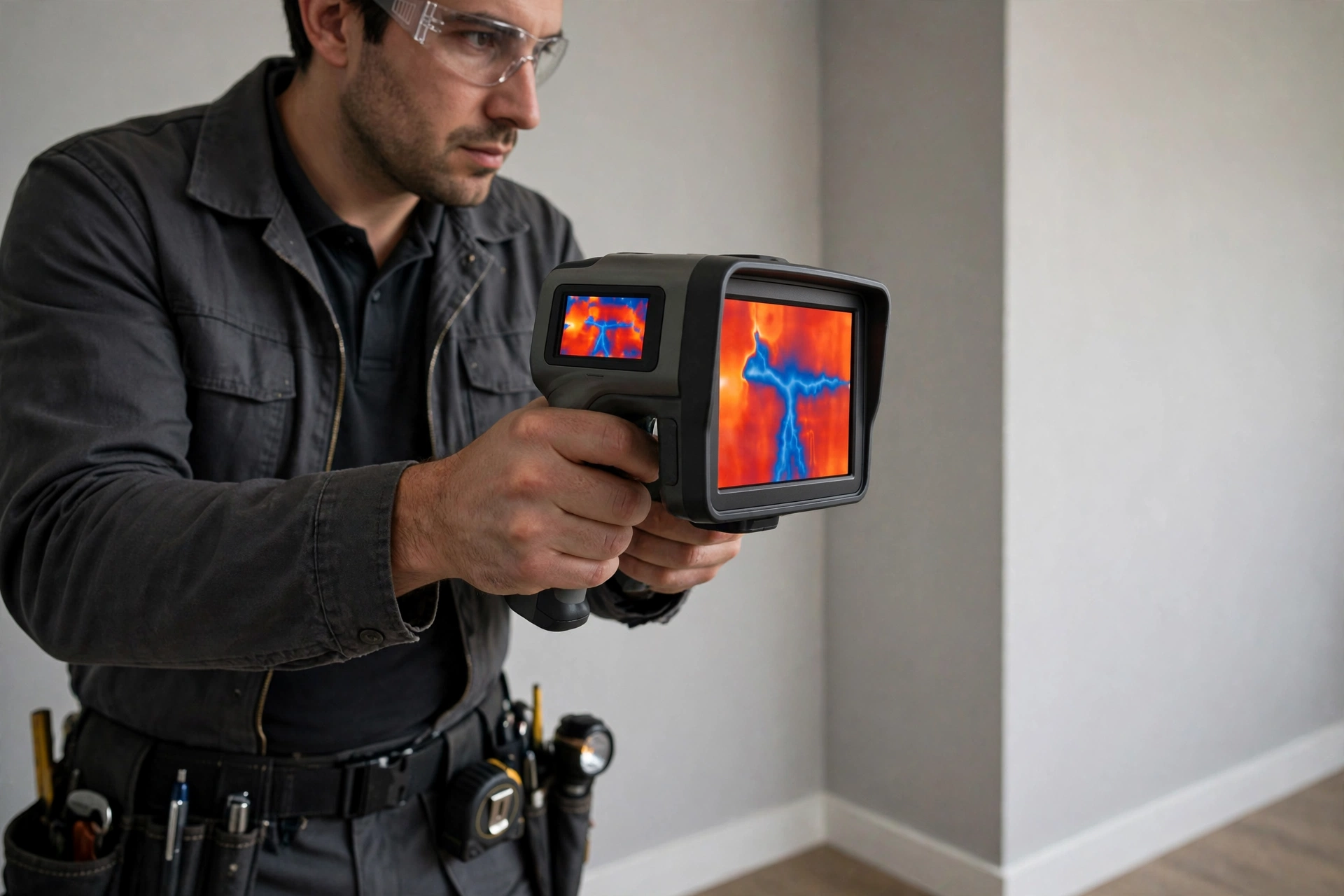
Thermal imaging: seeing the heat
An infrared camera visualizes surface temperature. Hot-water leaks warm the surface above them; cold-water leaks cool it through evaporation. The camera renders these as color maps — instantly revealing patterns invisible to the eye. It's non-contact, safe, and the fastest way to scan large areas.
Tracer gas: following the molecules
For leaks too quiet to hear, a safe hydrogen/nitrogen gas is introduced into the isolated pipe. The tiny molecules escape at the break, rise through soil and concrete, and are detected at the surface by an ultra-sensitive sniffer. Where readings peak, the leak sits.
Pressure testing: proving it
Isolating pipe sections and monitoring pressure (or water level, for drains) gives a definitive yes/no: this section holds, or this section leaks. It's the method that turns suspicion into proof — and verifies repairs afterward.
Moisture mapping: measuring the spread
Pin and pinless moisture meters take systematic readings across walls, floors, and ceilings, building a quantitative map of exactly where water has traveled. Essential for insurance documentation and for ensuring repairs address the full extent.
Camera inspection: seeing inside drains
A waterproof camera travels through sewer and drain lines, showing cracks, roots, and blockages on a live monitor — with each defect's location marked above ground.
Why pros combine methods
No single method is perfect for every situation: acoustic struggles on plastic pipe, thermal needs temperature difference, tracer gas needs an isolatable section. Professionals layer methods — acoustic to bracket, thermal to map, tracer gas to pinpoint, pressure to prove — because the combination is dramatically more reliable than any one tool alone. That's the difference between detection as a specialty and guessing with a single gadget.
Common Questions
Can a leak be detected without breaking walls?
Yes — that's the entire discipline. Acoustic, thermal, tracer gas, and moisture-mapping methods all work from the surface. Walls are opened only after the pinpoint, at one marked spot, by your repair contractor.
How accurate is professional leak detection?
On suitable pipe, combined methods routinely locate within inches. Accuracy depends on pipe material, depth, and conditions — which is why professionals confirm with a second method on critical jobs rather than relying on one reading.
How long does professional leak detection take?
Most residential jobs complete in a single visit of one to three hours. Complex cases — long underground runs, multiple zones — can take longer, but you'll know the plan upfront.
What is acoustic leak detection?
Using sensitive microphones to hear the vibration of pressurized water escaping a pipe, then tracing the sound to its loudest point — the leak. It's the foundational method for pressurized supply lines.
Suspect a Leak? Don't Guess — Detect.
Every day a hidden leak runs costs you water and risks damage. Call now for professional, non-invasive leak detection in Santa Fe, NM — open 24/7.