Swimming Pool Leak Detection in Santa Fe, NM
Losing more than a quarter-inch a day? That's not evaporation — that's a leak. We test the shell, fittings, and underground plumbing separately to find exactly where your pool is losing water.
Understanding Swimming Pool Leak Detection in Santa Fe
Santa Fe's intense sun and dry air evaporate pool water fast — which makes it easy to dismiss real leaks as 'just evaporation.' The rule of thumb: up to a quarter-inch per day can be evaporation; consistently more means water is escaping through the shell, a fitting, or the underground plumbing.
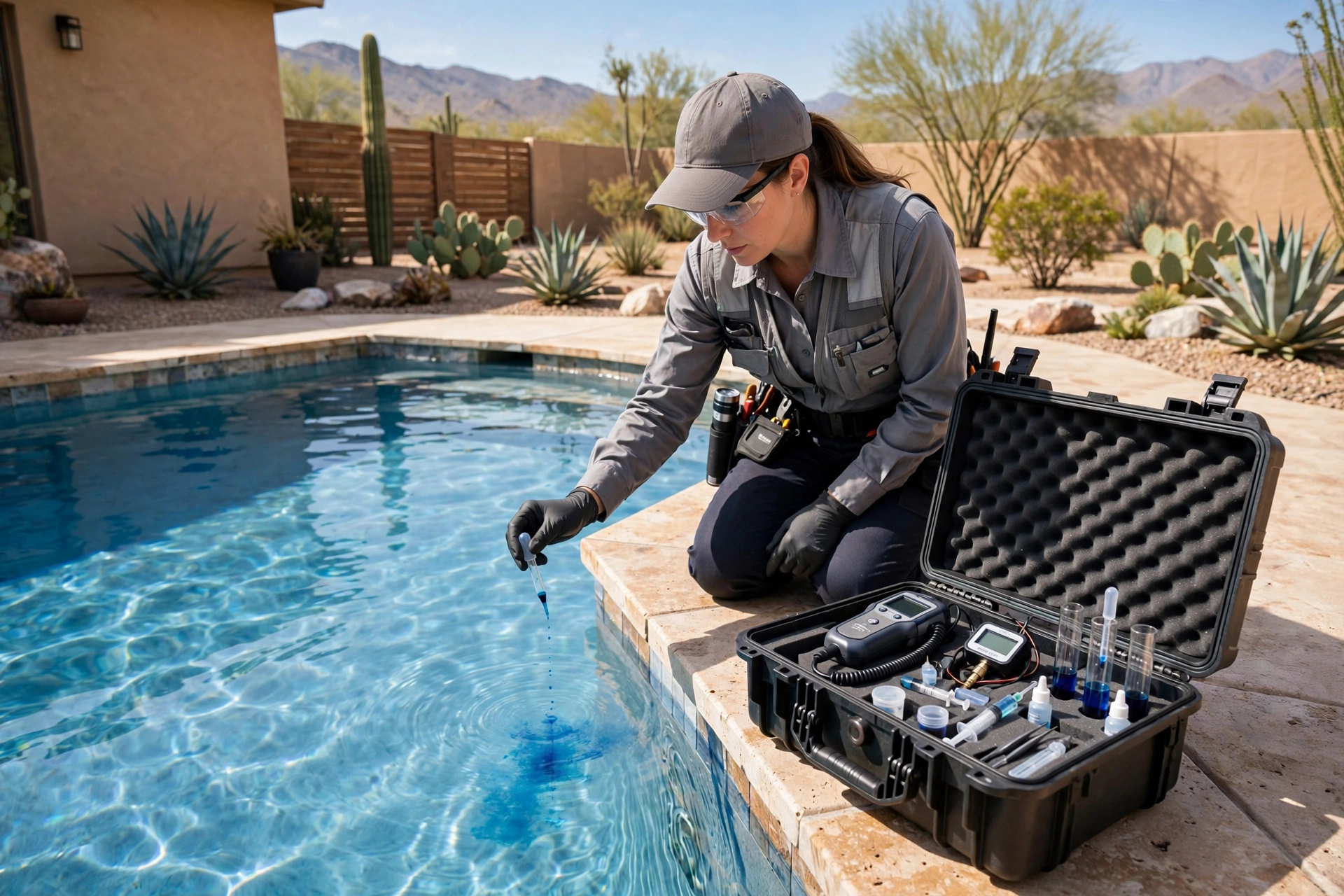
Pool leak detection is a process of elimination done professionally. We start with the bucket test to confirm the leak versus evaporation, then isolate the shell from the plumbing with pressure tests, dye-test fittings, and acoustically or tracer-gas check underground lines. Each subsystem is proven guilty or innocent in turn — so the repair targets the real failure, not a guess.
Signs You May Need Swimming Pool Leak Detection
If any of these sound familiar, don't wait — hidden problems compound daily.
Losing more than ¼ inch per day
The evaporation threshold. Consistently beyond it, you have a leak.
Autofill running constantly
An autofill that never shuts off is replacing lost water around the clock.
Wet spots around the pool or deck
Saturated soil or deck areas indicate underground plumbing leaks.
Air in the pump basket
Air infiltration on the suction side often accompanies a suction-line leak.
High water bill plus pool
The pool's makeup water shows up as a bill spike with no other explanation.
Algae despite good chemistry
Constant fresh-water dilution from a leak destabilizes chemical balance.
What Causes It
- Skimmer throat separation or cracks
- Return line and light-niche failures
- Underground plumbing breaks from soil movement
- Shell cracks in gunite, plaster, or vinyl
- Worn pump seals and equipment pad leaks
Our Swimming Pool Leak Detection Process
Thorough, transparent, and built around one visit that answers everything.
Bucket test
A bucket on the pool step isolates evaporation from leaking — 24 hours gives a definitive answer.
Visual & equipment inspection
Skimmer, returns, light niche, pump, filter, and heater are inspected for visible failures.
Plumbing pressure testing
Each underground line is isolated and pressure-tested to prove which one leaks.
Dye testing
Suspect fittings and cracks are dye-tested — dye visibly flows toward the leak point.
Underground pinpointing
Failed lines are traced with acoustic or tracer-gas methods and marked for repair.
Technology We Use for Swimming Pool Leak Detection
Professional-grade methods — matched to your situation.
Bucket test
The definitive DIY-friendly first step: distinguishes evaporation from leaking with simple physics.
Pressure testing rigs
Isolate skimmer, main drain, and return lines independently to identify the failing circuit.
Dye testing
Syringe-applied dye reveals exactly where water is being drawn into a crack or failed fitting.
Acoustic & tracer gas
Pinpoint underground plumbing breaks without digging up the deck.
Benefits of Professional Swimming Pool Leak Detection
Finding it fast — and precisely — changes everything about what happens next.
Stop the water (and chemical) waste
A leaking pool wastes water, chemicals, and heat — finding it stops all three.
Protect the shell and deck
Long-term leaks undermine decking and damage shell structures. Early location prevents bigger repairs.
Know which fix you need
Shell patch, fitting reseal, or plumbing repair are very different jobs — detection tells you which one.
Verify before you pay
Post-repair pressure testing proves the fix held before the contractor leaves.
Property Types We Serve
Swimming Pool Leak Detection — FAQs
How do I know if my pool is leaking or just evaporating?
Do the bucket test: place a bucket on a pool step, fill it to match the pool level, mark both, and wait 24 hours with the pump running normally. If both drop equally, it's evaporation. If the pool drops more, you have a leak.
How long does pool leak detection take?
Most residential pool investigations are completed in a single visit of two to four hours: bucket-test review, equipment inspection, pressure testing of the plumbing circuits, and dye testing of suspect fittings.
Where do pools leak most often?
The skimmer throat, return fittings, and light niche are the most common shell-side failures; underground, it's usually a return or suction line break. Equipment-pad leaks at pump seals and unions are also frequent.
Can cracked pool tiles cause leaks?
Cracked tiles alone rarely leak — they're cosmetic over the waterproof shell. But the same impact or movement that cracked tiles can also crack the shell beneath, which is why dye testing of the area matters.
Do you have to drain the pool to find the leak?
Almost never. Diving inspections, dye testing, and pressure testing are all performed with the pool full. Draining is avoided because an empty pool can damage the shell and liner.
Related Services
Spa & Hot Tub Leak Detection
A hot tub that needs constant topping off has a leak — in the equipment, the shell, or the plumbing between th…
Learn more →🕳️Underground Water Line Leak Detection
A buried supply line can leak thousands of gallons into the soil with nothing visible on the surface. We trace…
Learn more →💧Electronic Moisture Mapping
A visible stain is only the edge of the moisture. Electronic moisture mapping measures and documents the full …
Learn more →Suspect a swimming pool leak detection issue in Santa Fe?
Don't wait until a small leak becomes a big repair. Call now — we answer 24/7 and pinpoint it without tearing your property apart.