Acoustic Pipe Leak Detection in Santa Fe, NM
Pressurized water escaping a pipe makes a distinct vibration — inaudible to you, crystal clear to our sensors. Acoustic detection traces that sound through concrete, soil, and walls to the exact leak point.
Understanding Acoustic Pipe Leak Detection in Santa Fe
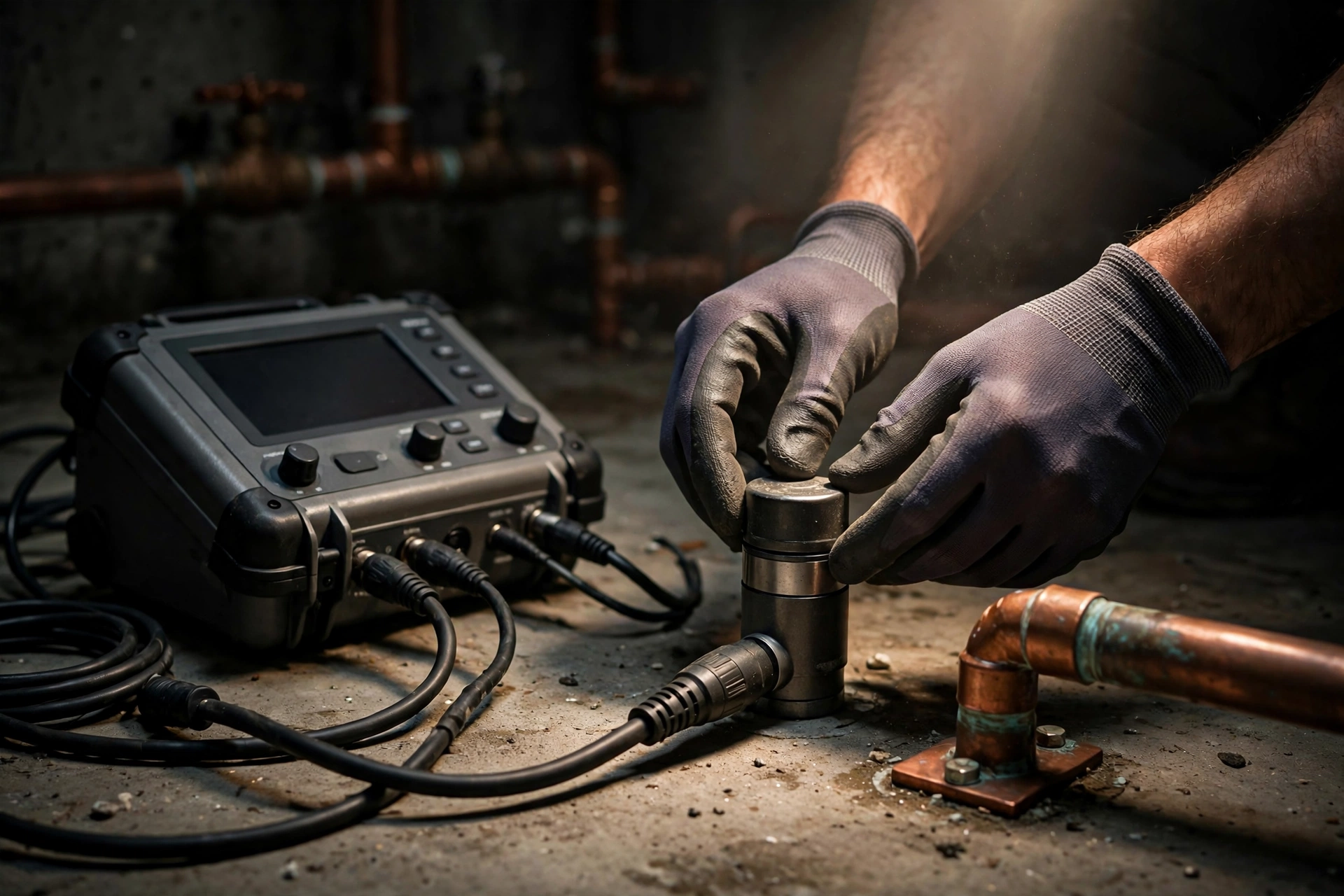
Acoustic pipe leak detection is the foundational technology of modern leak locating: highly sensitive microphones and ground sensors pick up the vibration created when pressurized water forces its way through a break. By comparing signal strength at multiple listening points, a trained technician traces the sound to its loudest point — the leak.
In Santa Fe it is the first method we reach for on pressurized supply lines: slab leaks, service lines, and underground runs. It works through concrete slabs, adobe walls, and soil without any opening of surfaces, and when combined with correlators it can triangulate leaks on long pipe runs within inches.
Signs You May Need Acoustic Pipe Leak Detection
If any of these sound familiar, don't wait — hidden problems compound daily.
Hissing behind walls or under floors
The sound of escaping pressurized water — often described as a hiss or rush — is exactly what acoustic sensors are built to find.
Water bill spike, house is dry
When the meter proves a leak but nothing is visible, acoustic listening traces the hidden pressurized line.
Leak suspected under slab or paving
Where excavation is expensive, acoustic methods locate from the surface first.
Pressure loss with no visible source
A line losing pressure is leaking somewhere — sound reveals where.
Need to verify a repair held
Post-repair acoustic checks confirm the signature is gone.
Our Acoustic Pipe Leak Detection Process
Thorough, transparent, and built around one visit that answers everything.
Listening point survey
We identify valves, meters, hose bibs, and cleanouts — every accessible contact point with the pipe network.
Systematic listening
Electronic listening equipment samples each point, ranking signal strength to map the leak's neighborhood.
Ground microphone tracing
Sensors on floors, soil, or walls refine the position by finding the loudest point.
Correlator triangulation (long runs)
On service lines and mains, two sensors bracket the section and software calculates the exact position.
Mark & report
The pinpoint is marked and documented with the method trail for your contractor.
Technology We Use for Acoustic Pipe Leak Detection
Professional-grade methods — matched to your situation.
Ground microphones
Surface sensors that amplify structure-borne leak noise through concrete, soil, and paving.
Acoustic correlators
Dual-sensor systems that triangulate leak position on long runs via sound-delay mathematics.
Electronic listening sticks
Contact probes for valves, meters, and exposed pipe — the starting grid of every survey.
Hydrophones
In-pipe sensors for maximum sensitivity on large or deep lines.
Benefits of Professional Acoustic Pipe Leak Detection
Finding it fast — and precisely — changes everything about what happens next.
Truly non-invasive
No cutting, no digging, no opening walls — the entire survey happens from accessible surfaces.
Fastest first answer
An experienced technician can often bracket a leak's location within the first hour on site.
Works on most pipe materials
Copper and metal pipe transmit sound best; results on plastic pipe are interpreted with adjusted technique.
Combinable with every other method
Acoustic findings guide where thermal, tracer gas, or camera work should focus — it multiplies every other tool.
Property Types We Serve
Acoustic Pipe Leak Detection — FAQs
How does acoustic leak detection work?
Escaping pressurized water vibrates the pipe and surrounding material. Sensitive microphones pick up that vibration through concrete, soil, or walls. By comparing loudness at multiple points, the technician traces the sound to its source — the leak.
Can it find leaks without digging or opening walls?
Yes. The entire survey is conducted from the surface — listening at valves, meters, and on floors or ground above the pipe. Excavation or opening happens only after the pinpoint, at the marked spot.
When is acoustic detection less effective?
On non-pressurized drain lines (nothing to make noise), on plastic pipe (which transmits sound poorly), and in very noisy environments. In those cases we switch to or combine with tracer gas, thermal imaging, or camera inspection.
How accurate is acoustic leak detection?
On suitable pressurized pipe, correlators and careful ground-microphone work routinely triangulate within inches. Accuracy depends on pipe material, depth, pressure, and background noise — which is why we confirm with a second method on critical jobs.
Is it combined with other methods?
Routinely. Acoustic is the fastest bracketing tool; thermal imaging, tracer gas, or pressure testing then confirm the exact point. The combination is more reliable than any single method.
What does the technician actually do on site?
They walk the property listening at every contact point — meter, valves, hose bibs, fixtures — ranking signal strength, then refine with ground microphones over the suspect area until the loudest point is found and marked.
Related Services
Slab Leak Detection
A leak under your concrete slab can waste thousands of gallons and undermine your foundation for months before…
Learn more →🕳️Underground Water Line Leak Detection
A buried supply line can leak thousands of gallons into the soil with nothing visible on the surface. We trace…
Learn more →🔧Main Water Line Leak Detection
The service line from your street meter to your house is your responsibility — and when it breaks, the water (…
Learn more →📊Digital Leak Correlation Testing
On long pipe runs, listening by ear isn't enough. Digital correlators use sensors at two points and precise ma…
Learn more →Suspect a acoustic pipe leak detection issue in Santa Fe?
Don't wait until a small leak becomes a big repair. Call now — we answer 24/7 and pinpoint it without tearing your property apart.